
Sustainable innovation.
Real impact.
All rights reserved. | Privacy Policy
The Vicious Circle of Alternative Protein Developments — Can Research and Industry Break It?
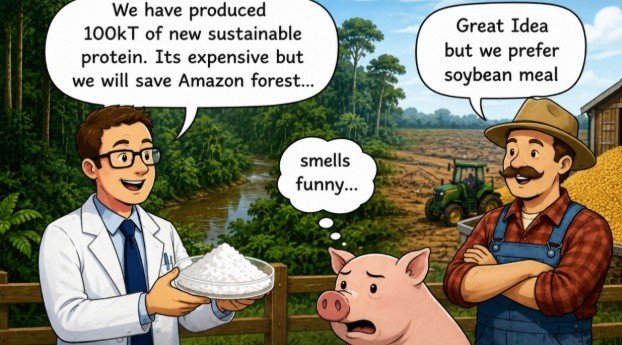
Alternative proteins are still expected to transform the future of food. Strong sustainability narratives, technological breakthroughs and major investments have created enormous momentum across insect proteins, precision fermentation, microbial biomass and novel ingredients. Yet despite significant technological progress, many companies continue to struggle commercially. What we increasingly observe is a “vicious circle” in alternative protein development.
Sustainability Creates the Vision — Scale Creates the Pressure
Most alternative protein platforms begin with a strong sustainability ambition: reducing environmental impact, improving resource efficiency and replacing traditional protein systems. At the same time, many of these technologies are built around industrial-scale production models from the very beginning. From an economic perspective, this is understandable — capital-intensive technologies often require high production volumes to achieve viable unit economics and justify infrastructure investment. However, large-scale production also requires stable, high-volume markets. This is where the first structural conflict begins to emerge.
Market segmentation is often presented as the solution — and in many ways it can be. However, segmentation only works when each market is deeply understood and real customer problems are clearly identified and addressed.
Animal Feed: The Scale Dream
The logical first target market is usually animal feed: huge demand, scale potential and continuous protein need. This strategy has been visible across several insect and microbial protein ventures, where industrial-scale ambitions were closely tied to feed applications. But feed is not simply a “high-volume outlet” for innovation. It is one of the most economically demanding sectors in the food chain, where success depends on competitive pricing, reliability and operational practicality. Sustainability alone is rarely enough to justify adoption. Underestimating the complexity of the feed market simply to support scale assumptions can become an extremely expensive strategic mistake.
Pet Food: Higher Margins, Higher Complexity
The next move is often pet food. At first glance, the market appears attractive: higher margins, relatively high volumes and premium positioning. However, pet food introduces a completely different challenge. Unlike feed, this market is heavily shaped by human behaviour and emotional decision-making. Ingredient perception, trust, palatability and “humanisation” trends often become just as important as technical functionality. Some raw materials have historically developed negative reputations regardless of scientific evidence. As a result, technological performance alone is rarely enough to secure adoption.
Functional Human Foods Challenge
The industry then often shifts toward sports nutrition, wellness and specialised functional foods. Margins can be attractive. However, volumes are relatively small and competition is intense. At the same time, modern consumers are becoming increasingly informed and evidence-driven, expecting validated functionality and clear scientific support before adopting new products or ingredients. As a result, product development is becoming more resource-intensive and scientifically demanding for long-term success.
Large-Scale Ambitions Before Market Demand
In my view, the biggest challenge facing alternative proteins is often not the technology itself. The pattern of scaling production before real market demand can be observed across multiple alternative protein sectors, including insect proteins, microbial biomass and precision fermentation. Perhaps the future of alternative proteins will depend less on “scaling first” and more on building deeply customer-focused solutions designed around clearly defined and addressed customer needs from the beginning.
Innovation alone is not enough, Customer- centric NPD is essential.
Alternative protein development cannot rely only on technological breakthroughs or sustainability narratives. Successful innovation requires a deep understanding of each target market and its realities. Importantly, users and customers should be part of the development journey from the very beginning, rather than being introduced only after scale-up has already been established. Without this alignment, even highly innovative technologies can struggle to achieve sustainable market adoption.